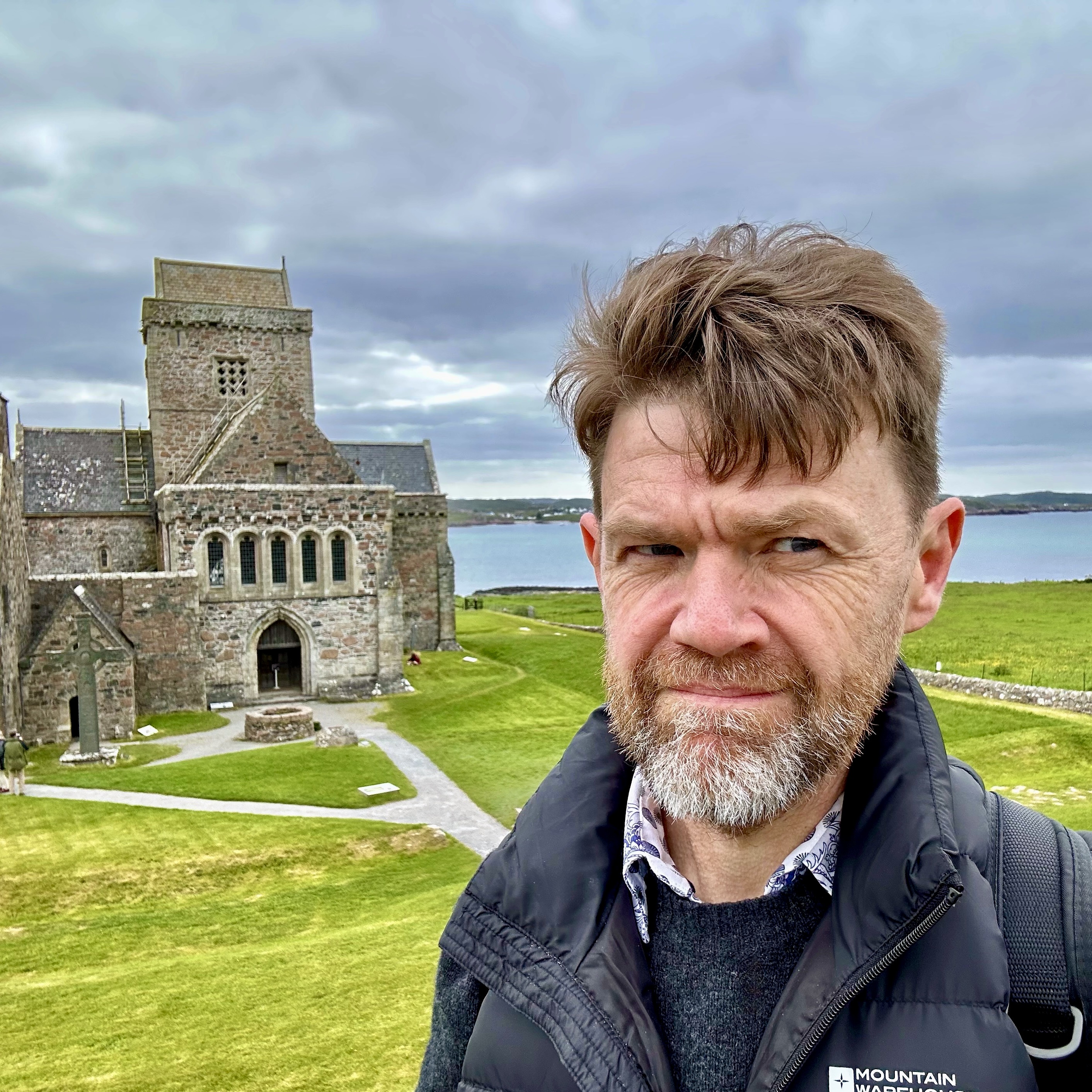
I’ll try this conference blogging thing, to see how it goes.
Logic Colloquium has started, with the opening address by Charles Parsons from Harvard. His talk was on Paul Bernay’s later philosophy of mathematics — a subject of which I knew nothing. So I learned a bit. After Bernays’ collaboration with Hilbert at Göttingen, he left Germany because of Nazi persecution, and spent the rest of his working life in Switzerland. His philosophy of mathematics (according to Parsons) post war is characterised by his response to Gödel’s results and the failure of Hilbert’s program. For Bernays, mathematical truth is not necessarily a priori in any strong sense – mathematical claims are verified in the competition of different conflicting mathematical theories, in just the same way that scientific theories are verified in competition with other theories. The category of the a priori is relativised into the weaker catergory of the antecedent. There are always beliefs or theories antecedent to our views, which may be examined, clarified and accepted and rejected. But nothing makes those especially immune from criticism or revision.
This might sound like a Quinean holism, but it’s not. It is motivated by a kind of neo Kantianism, and Bernays shares none of Quine’s empiricism.
Another of Parsons’ points was that Bernays had a distinctive kind of platonist structuralism, akin in one sense to Carnap’s view of mathematical truth. He had a similar distinction between internal and external questions – the theory itself tells us that there exists a prime between 15 and 19, at it tells us that 17 is prime – and that’s all there is to exsitence, from the point of view of inside the theory. It makes no sense to ask that quesiton outside the theory.
What made Bernays’ platonism distinctive, according to Parsons, was that he thought that you could have degrees of platonic existence for mathematical objects. There was more or less objective existence depending on different criteria. This reminds me of the Crispin Wright material on the degree to which a discourse might be apt for objective truth (cognitive command, wide cosmological role etc.), so I wonder if there’s any connection there.
In his talk, Parsons pointed to the Bernays Project to translate his works into English. A lot of the material is available online, so you can have at it yourself.
After the talk there was a concert, and a reception. At the latter I was able to catch up with people that I’ve corresponded with, like Albert Visser and Richard Zach. Such nice people being around means that this should be a fun conference. Now it’s time for some sleep before tomorrow’s activity. I need to be awake for at least one class.